Overview
Medicare lead management is the system agents use to capture, track, and follow up with every prospect from first contact to closed sale. The agents converting the most leads aren't working more hours; they're following a tighter process: instant first response, organized medicare lead tracking by pipeline stage, and consistent follow-up that doesn't depend on memory. This guide breaks down the exact best practices behind strong medicare lead management, where most agents lose leads without realizing it, and how solid medicare client management turns one-time prospects into long-term renewals.
Key Takeaways
- Most lost Medicare leads aren't lost to a better competitor. They're lost to slow or inconsistent follow-up.
- Solid medicare lead management starts with instant response, not eventual response.
- Medicare lead tracking should live in one organized system, not three notebooks and a memory.
- Medicare client management doesn't stop at the sale — renewals and reviews depend on it too.
- Agents who follow a repeatable process consistently outperform agents who rely on hustle alone.
Introduction
Here's something most new agents don't want to hear: how well you sell matters less than how fast and how consistently you follow up.
A prospect who fills out a form today is comparing options today. If your reply comes tomorrow, you're not competing against your pitch anymore; you're competing against whoever replied first. This is the entire case for treating medicare lead management as a system, not a habit you get to when you have time.
Agents who build a real process around this don't just close more. They stop losing deals to competitors who simply moved faster on the same lead.
The Five Pillars of Strong Medicare Lead Management
1. Instant Capture
Every lead, whether it comes from a call, a form, a referral, or a walk-in, needs to land somewhere immediately. If a lead sits in your head, a sticky note, or a missed call log, it's already at risk. Capture has to happen the second contact is made, not at the end of the day when you finally catch up.
2. Fast First Response
Speed beats almost everything else early in the process. A prospect who hears back within minutes is far more engaged than one who waits hours. This single habit, responding fast every time, is the biggest lever in medicare lead management, full stop.
3. Staying Organized as Leads Move
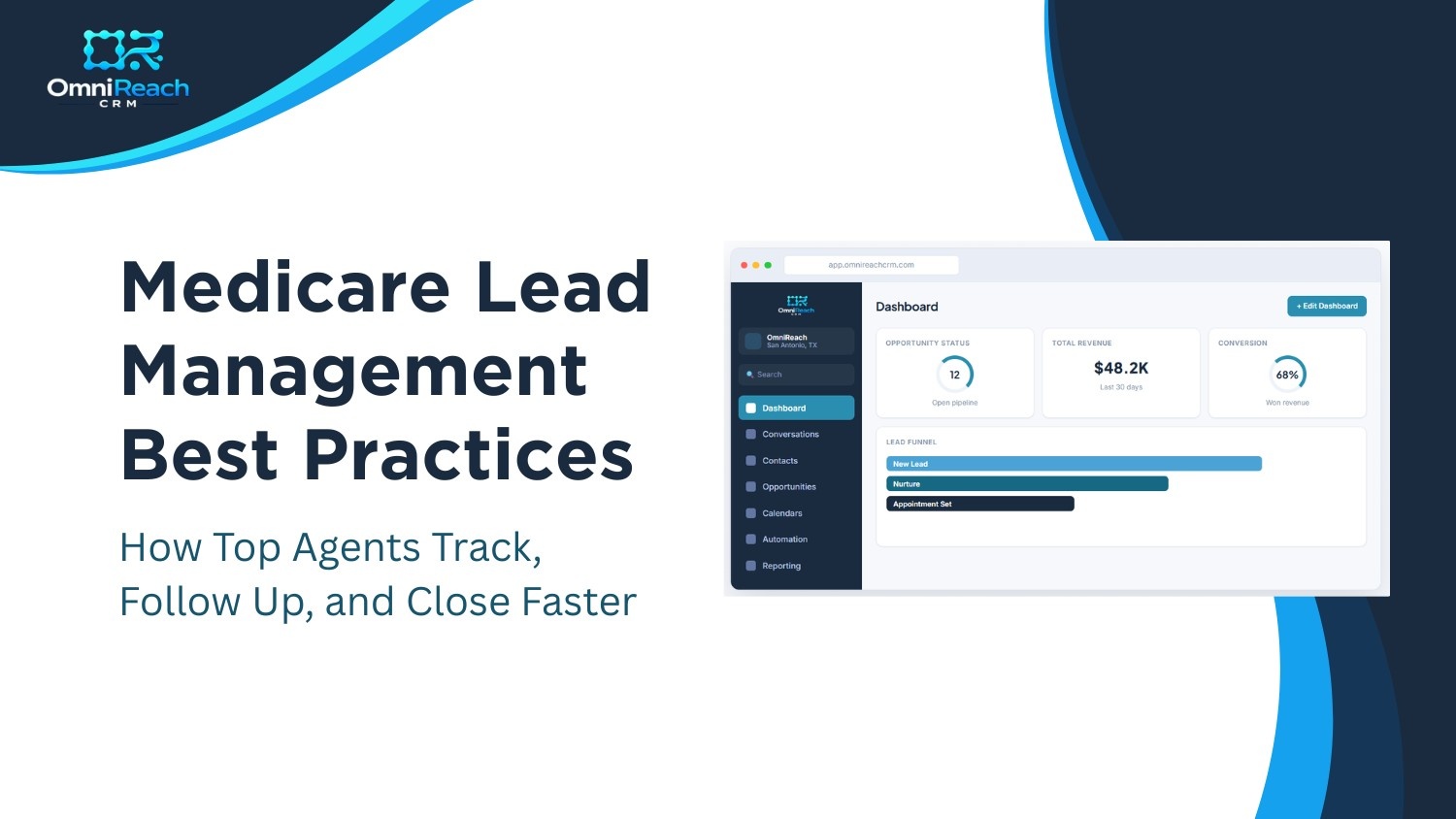
Once a lead is captured and contacted, it needs a home. Good tracking means knowing exactly where every prospect stands at any given moment: New Lead, Nurture, Appointment Set, Sold. Without this, agents end up calling the same person twice, sending the same text to someone who already booked, or worse, forgetting a warm prospect entirely until it's far too late to matter.
4. Consistent Follow-Up Sequences
One text isn't a follow-up strategy. Most Medicare decisions take more than one conversation, which means a missed second or third touch can quietly kill a deal that was actually still warm. Building a repeatable follow-up rhythm that doesn't rely on memory is what separates agents who close consistently from agents who close by accident.
5. Ongoing Client Follow-Through
Lead management doesn't end at the signature. Real post-sale tracking keeps every policy, conversation, and renewal date organized long after the deal closes, so check-ins, plan reviews, and AEP outreach happen on schedule instead of falling through the cracks a year later when nobody's paying attention anymore.
Common Mistakes That Quietly Kill Conversion
| The Mistake | Why It Hurts You |
|---|---|
| Replying "when you get a chance" | Competing agents reply in minutes, not hours |
| Tracking leads across notebooks, texts, and memory | Leads get duplicated, missed, or forgotten |
| One follow-up attempt, then giving up | Most prospects need 3+ touches before deciding |
| No system for renewal or review dates | Clients churn quietly when nobody checks in |
| Treating every lead the same way | Hot leads need urgency; cold leads need patience |
Every row on that list is fixable. None of them require working harder, just working with a system that doesn't rely on you remembering everything perfectly.
What Good Lead Tracking Actually Looks Like
Strong medicare lead tracking isn't complicated. It just needs to answer three questions instantly, for any lead, at any time:
- Where is this person in the process right now?
- When was the last time someone talked to them?
- What's the next action, and when should it happen?
If you can't answer all three in under ten seconds for a random lead in your pipeline, your medicare lead management system isn't doing its job yet, no matter how organized it feels day to day.
Building a Follow-Up Rhythm That Actually Holds Up
A loose follow-up plan looks like calling back "soon." A real one looks like this:
- Minute one: Instant acknowledgment — a text or call confirming you got their info.
- Day one: A real conversation or voicemail with a clear next step.
- Day three: A check-in if there's been no response yet.
- Day seven: A value-add touch — a question answered, a plan comparison, something useful.
- Ongoing: Scheduled nurture touches until the lead either converts or clearly opts out.
This rhythm doesn't need to be memorized. It needs to be built into whatever system handles your medicare lead management, so it runs whether you're at your desk or not.
Why the Relationship Doesn't End at the Sale
Closing the policy isn't the finish line; it's the start of the relationship that actually pays off long-term. Strong post-sale management means:
- Tracking renewal and review dates so nothing slips a year later
- Logging every call and conversation so any future touchpoint has full context
- Flagging clients aging into new plan eligibility or needing a coverage check
- Catching dissatisfaction early, before it turns into a lost client at AEP
Agents who treat the sale as the end of the process lose clients quietly, one missed renewal call at a time. Agents who keep managing the relationship build a book that compounds year over year.
It's worth saying plainly: the agents with the biggest books in this industry rarely got there from one great year of selling. They got there by holding onto the clients they already won, year after year, because nobody else had a reason to call before they did.
The Bottom Line
Medicare lead management isn't about doing more; it's about doing the same handful of things every single time, without depending on memory, mood, or how busy the day got. Instant capture, fast response, clear tracking, real follow-up, and ongoing client management: that's the whole list, and it doesn't change no matter how big your book gets.
The agents pulling ahead this year aren't the ones grinding the longest hours. They're the ones running a process tight enough that no lead falls through simply because nobody remembered to follow up.
Stop Letting Process Gaps Cost You Policies
Every lead that goes cold from a missed follow-up is a failure of medicare lead management, not a failure of effort — and it's a policy you already paid to generate and never collected on. That's not a small leak; it adds up fast across a full year of leads.
OmniReach was built around exactly this kind of medicare lead management: automatic capture, instant first-response texting, organized pipeline tracking, and ongoing medicare client management that keeps renewals and reviews from slipping through the cracks. One system, not five tools stitched together with hope.
The agents who tighten this process this month stop losing the leads they were already paying for, starting with the next one that comes in. Book your free demo with OmniReach and see your exact pipeline running inside the platform before you commit to anything.
Start Managing Your Medicare Leads the Right Way
See automatic capture, instant follow-up, organized pipeline tracking, and post-sale client management — all in one system. Request a free demo today.
Book a Free Demo →Frequently Asked Questions (FAQs)
How fast should I respond to a new Medicare lead?
Within minutes, not hours. Prospects compare multiple agents at once, and the first agent to respond with a real answer usually wins the conversation before pitch quality even comes into play.
How many follow-up attempts does a Medicare lead actually need?
Most leads need three or more touches before deciding. Stopping after one attempt is one of the most common reasons warm leads quietly go cold.
What's the difference between medicare lead tracking and ongoing client management?
Lead tracking covers the path from first contact to closed sale. Client management picks up after that: renewals, reviews, and ongoing communication for the life of the relationship.
Can I manage Medicare leads without specialized software?
Technically yes, but it falls apart fast. Spreadsheets and notebooks don't send reminders, track stages automatically, or stop you from forgetting a follow-up during a busy week.
Why do agents lose clients even after a successful sale?
Usually because nobody tracked the renewal date or scheduled a check-in. Without ongoing medicare client management, clients quietly drift toward whoever reaches out next.