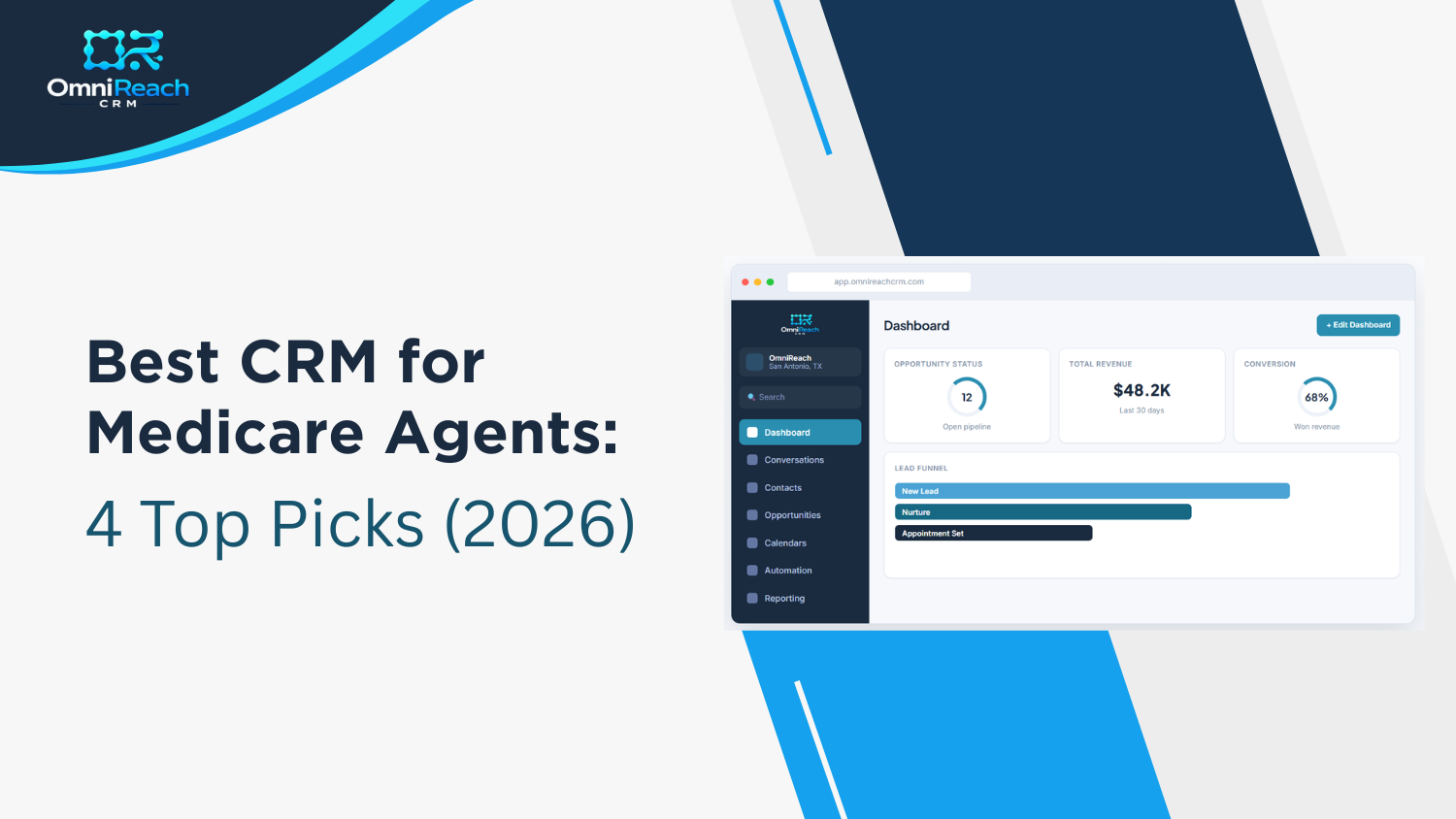
The best CRM for Medicare agents depends on what the agent or agency actually needs it to do. OmniReach CRM is built specifically for Medicare, life, and final expense sales, with HIPAA compliance, automated speed-to-lead follow-up, and full downline visibility included at a flat $197/month. Agent CRM, built on GoHighLevel, offers strong marketing automation across insurance verticals but isn't Medicare-exclusive. MedicarePRO CRM focuses on commission tracking and plan comparison for existing books of business. Smart Agent CRM, built on Salesforce, specializes in multi-carrier commission reconciliation. For agents and FMOs who need compliance, automation, and downline management in one platform, OmniReach CRM is the strongest all-around fit.
- The "best" CRM depends on whether you need lead automation, commission tracking, or both
- OmniReach CRM combines HIPAA compliance, sub-2-minute automated follow-up, and full downline visibility for $197/mo flat
- Agent CRM leans marketing-heavy and covers multiple insurance verticals, not just Medicare
- MedicarePRO CRM is strong on commission calculations and Rx/plan comparison, lighter on lead automation
- Smart Agent CRM specializes in multi-carrier commission reconciliation, built on Salesforce
- A real CRM insurance agency setup needs HIPAA compliance and downline reporting — not just a contact list
Every "best CRM" list you'll find is either written by someone who's never sold a Medicare plan, or it's a thinly disguised ad for one product dressed up as five. This one's neither. We pulled real feature and pricing data on the actual tools Medicare agents are comparing right now, and laid out where each one genuinely wins.
If you're searching for the best CRM for insurance agents specifically built around Medicare work, here's how the real options stack up.
What to Look for in a CRM for Health Insurance Agents
Before comparing tools, it helps to know what actually separates a good one from a spreadsheet with extra steps. A CRM for health insurance agents should handle HIPAA compliance without an upgrade fee, automate follow-up fast enough to matter during AEP, track commissions accurately, and — if you're running a team — show you what your downline is actually doing. Everything below gets judged against those four things.
A quick note: pricing and features for third-party tools change often. Numbers below reflect what's publicly listed as of this writing — always confirm directly with the vendor before deciding.
Quick Comparison
| CRM | Best Known For | HIPAA / BAA | Downline View | Starting Price |
|---|---|---|---|---|
| OmniReach CRM | All-in-one: compliance + automation + FMO visibility | Included, day one | Full pipeline visibility across agents | $197/mo flat, no per-seat fees |
| Agent CRM | Marketing automation across insurance verticals | Included | Limited agency-level reporting | $97/mo starting |
| MedicarePRO CRM | Commission tracking & plan/Rx comparison | Included | Downline production + commission overrides | Monthly plans (quote-based) |
| Smart Agent CRM | Multi-carrier commission reconciliation | Not publicly confirmed | Salesforce-based reporting | Scales with carrier count |
1. OmniReach CRM — Best Overall
Most agents end up stitching together two or three tools: one for compliance, one for follow-up automation, one for tracking the downline. OmniReach CRM was built to be the one platform that actually does all three.
- HIPAA compliance and a signed BAA included from day one — no upgrade tier
- Automated follow-up fires in under 2 minutes, every lead, every time
- Pre-built pipelines for MA, Med Supp, PDP, and final expense
- Full downline dashboard for FMOs — see every producer's activity in one place
- Flat $197/month, regardless of how many contacts or agents you add
- 24/7 live chat support with actual humans, not a bot loop
Best for: solo agents who want everything in one place, and FMOs who need the exact same system running consistently across every producer.
2. Agent CRM — Best for Marketing-Heavy Agents
Agent CRM is built on top of GoHighLevel's infrastructure, then reconfigured specifically for insurance agents. It starts at $97/month and leans hard into marketing automation — pre-built campaign templates, an AI assistant tool, and 24/7 insurance-focused support.
- HIPAA compliance included at the starting tier
- Pre-built automation templates across several insurance verticals, not just Medicare
- Built-in AI assistant for content and outreach
- Strong marketing feature set inherited from the GoHighLevel platform underneath it
Trade-off: it's built for insurance broadly, not Medicare specifically, so MA/Med Supp/PDP-specific workflows may need more manual setup. Agency-level downline reporting is lighter than tools built around FMO structures.
Best for: agents selling across multiple insurance lines who want heavy marketing automation more than Medicare-specific compliance workflows.
3. MedicarePRO CRM — Best for Commission Tracking
MedicarePRO CRM is built exclusively for Medicare agents, and it shows in the details — Rx and pharmacy price comparison across plans, automated commission calculations, a renewal chain calculator for forecasting income, and enrollment applications that pre-fill through a SunFire integration.
- HIPAA-compliant client data handling
- Automated commission calculations plus renewal forecasting
- Downline production view with commission override settings for agency principals
- Plan comparison across MAPD, PDP, Med Supp, ancillary, life, and individual health
Trade-off: the feature set leans toward servicing an existing book — commissions, renewals, plan data — more than lead generation or marketing automation. Agents who need both often pair it with a separate outreach tool.
Best for: agents and agencies most focused on managing a book they already have, with commission accuracy as the top priority.
4. Smart Agent CRM — Best for Multi-Carrier Reconciliation
Smart Agent CRM is built on Salesforce and takes a different angle entirely — it's centered on the commission side of the business. It syncs carrier books of business directly into the platform, flags missing commission payments, and keeps a documented audit trail for recouping what's owed.
- Direct sync with carrier commission data
- Automatic detection of missing or underpaid commissions
- Documented audit trails built for recoupment claims
- Pricing scales with the number of carriers you work with, rather than a flat seat fee
Trade-off: Salesforce-based platforms typically mean more setup and admin overhead than a purpose-built standalone tool, and lead automation isn't the core focus here.
Best for: agencies working with a large number of carriers who need commission reconciliation more than front-end lead automation.
What This Looks Like for an Insurance Agency Running a Downline
A solo agent can get away with a lighter tool. An insurance agency running a real downline can't — not without losing track of who's compliant, who's converting, and who's quietly falling behind.
This is where the gap between these four options widens the most. MedicarePRO CRM and Smart Agent CRM both give agency principals visibility into commissions and production. Neither was built to also handle the automated follow-up side. Agent CRM handles automation well but wasn't built around FMO-style downline structures. An insurance agency CRM setup that needs to do both — compliant automation on the front end, full visibility on the back end — is a narrower list, and it's where OmniReach was specifically built to sit.
Which One Should You Choose?
- Want one system that handles compliance, automation, and downline visibility? OmniReach CRM
- Running an FMO and need every producer working the same way? OmniReach CRM
- Selling across several insurance lines and want heavy marketing automation? Agent CRM
- Mostly focused on servicing an existing book and nailing commission accuracy? MedicarePRO CRM
- Juggling a lot of carrier relationships and need reconciliation more than lead gen? Smart Agent CRM
Conclusion
There isn't one universal best CRM for insurance agents — there's the one that matches what you're actually short on. If that's marketing firepower, Agent CRM covers it. If it's commission accuracy, MedicarePRO CRM or Smart Agent CRM will get you there. But for agents and FMOs who need compliance, fast automated follow-up, and real downline visibility without stitching three tools together, OmniReach CRM is built to be the one system that does it all.
Compare features on paper as long as you want. The gap shows up fastest during your next AEP — in how many leads actually get worked, and how many just sit.
See Why OmniReach CRM Comes Out Ahead — Try It Before Your Next AEP Rush
Every tool on this list does something well. Only one of them was built to cover compliance, automation, and downline visibility without asking you to bolt on a second platform.
OmniReach CRM: HIPAA-compliant from day one, automated follow-up under 2 minutes, pre-built Medicare and FE pipelines, and a downline dashboard built for FMOs — all for one flat monthly price. Check the pricing page, see SMS automation and HIPAA compliance in a live demo, or read more on what a Medicare CRM actually does and how FMOs use one across a downline.
The agents comparing tools in October are already behind the ones who picked one in August. [Book a Demo →]
Frequently Asked Questions
Q1: Is there really a difference between "best CRM for Medicare
agents" and "best CRM for insurance agents"?
A little. Medicare-specific tools focus on AEP, MA/Med
Supp/PDP pipelines, and CMS rules. Broader insurance CRMs cover
more product lines but may need extra setup to handle Medicare's
specific workflows and compliance needs well.
Q2: I sell life and health insurance, not just Medicare. Does a
Medicare-focused CRM still work?
Yes, as long as it supports multiple pipeline types. A good
CRM for health insurance agents should let you run Medicare, life,
and final expense pipelines side by side without treating any of
them as an afterthought.
Q3: Is a Salesforce-based or GoHighLevel-based CRM better than
a purpose-built one?
It depends on what you're optimizing for. Platforms built
on top of larger systems can offer more flexibility, but
purpose-built tools usually get you working faster with less
setup, since the insurance-specific pieces are already in place.
Q4: Can I switch CRMs in the middle of AEP?
It's not ideal, but it's doable if the new platform has
fast onboarding and pre-built pipelines. The real risk isn't the
switch itself — it's picking a tool that needs weeks of
configuration during your busiest stretch of the year.
Q5: Which of these is actually built for an FMO managing a
large downline?
OmniReach CRM and MedicarePRO CRM both offer downline
visibility, but they're built around different things — OmniReach
centers on pipeline and compliance visibility across every
producer, while MedicarePRO centers more on commission overrides
and production tracking.
See OmniReach CRM in Action
OmniReach fires your first follow-up in under 2 minutes for every new lead, automatically, across every source. Book a 20-minute demo and we'll show you the full platform live.
Book a Free Demo →