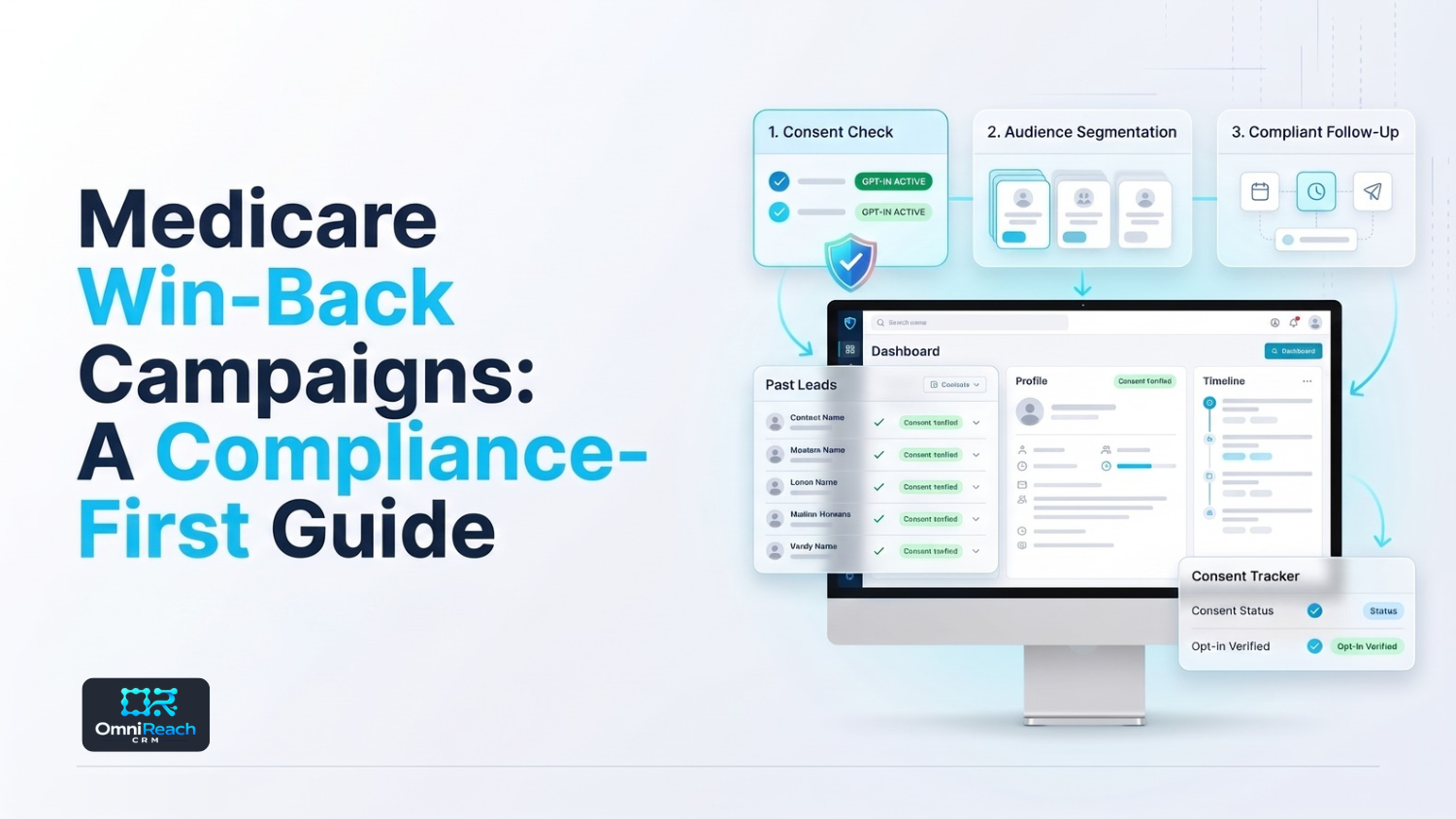
Overview
Every Medicare agent has contacts who never enrolled, leads who stopped responding, and former clients who moved to another plan or agent.
It can be tempting to put all these contacts into one automated win-back campaign. After all, they already know your agency. Some may simply have needed more time before considering their options.
But an old lead is not automatically given permission to make a marketing call or send a text. And a former client is not necessarily someone your agency can contact through an unsolicited sales campaign.
A successful Medicare win-back campaign starts with more than a contact list. It requires accurate segmentation, documented permission, appropriate messaging, and a process for honoring opt-outs.
In this guide, we’ll explain how Medicare agents can organize past leads and former clients, evaluate whether outreach is appropriate, build a controlled follow-up process, and measure campaign results.
This article provides general educational information, not legal advice. Medicare Advantage and Part D requirements, TCPA/FCC rules, state laws, and carrier policies may apply differently depending on the contact, communication method, and circumstances. Confirm your process with your compliance team and legal counsel.
AI Overview
Medicare win-back campaigns can help agencies organize follow-up with past leads and former clients, but the two groups require different handling. Start by separating prospects who never enrolled from individuals who previously enrolled and later left. Review the contact history, documented consent, communication preferences, and applicable restrictions before deciding whether outreach is permitted. Use appropriate communication channels, approved materials, and clear opt-out procedures. Track responses, appointments, complaints, and follow-up activity. A Medicare CRM can help organize records and internal tasks, but it does not create consent or guarantee compliance.
Key Takeaways
- Past leads and former clients should not be treated as the same audience.
- An old lead record does not automatically establish permission for calls or texts.
- CMS restricts unsolicited telephone solicitation to former Medicare enrollees.
- Check consent, communication preferences, do-not-call requirements, and carrier rules before outreach.
- Segment contacts by their history and documented permissions.
- Keep marketing content accurate and use applicable approved materials.
- Stop or suppress communications when a valid opt-out or revocation request is received.
- A Medicare CRM can organize contact records, consent documentation, and follow-up tasks, but compliance remains the responsibility of the agency and its agents.
Win-Back Campaigns for Past Medicare Leads and Former Clients
Somewhere in your CRM, there may be leads who stopped responding several months ago. You may also have former clients who changed plans, moved to another agent, or no longer work with your agency.
These contacts have different histories.
A prospect who requested information but never enrolled is not the same as a former Medicare Advantage enrollee who has since disenrolled. Their contact permissions, communication history, and applicable CMS restrictions may be different.
That distinction should determine what happens next.
A win-back process should not begin with sending a message to everyone on an old list. It should begin with reviewing the records and determining whether the proposed contact is appropriate.
Two Groups, Two Different Approaches
| Category | Past Leads | Former Clients |
|---|---|---|
| Who they are | Prospects who never enrolled through your agency | Individuals who previously worked with or enrolled through your agency |
| Information available | Lead source, contact history, request details, and consent records | Previous relationship, enrollment history, service notes, and recorded preferences |
| Main consideration | Whether the original request and consent support the proposed outreach | Whether CMS, carrier, and other applicable rules permit the proposed contact |
| Appropriate next step | Review the original request and documented permissions | Review former-enrollee restrictions and the reason for the previous relationship ending |
| CRM priority | Verify lead source and permission records | Verify former-client status, contact restrictions, and service history |
Do not place both groups into the same automated sequence.
A prospect who requested information may be eligible for a permitted follow-up, depending on the scope of the request and applicable rules. A former enrollee requires additional scrutiny because CMS specifically restricts unsolicited calls to former enrollees who have disenrolled or are in the process of disenrolling.
Step 1: Segment Contacts by Their History
Before creating a campaign, organize your records.
The reason a contact stopped communicating can help you understand the history of the relationship. However, a disposition code does not establish permission to contact someone.
Consider organizing records into categories such as:
- Not ready: The prospect previously requested information but did not proceed.
- No response: Previous contact attempts did not result in a conversation.
- Went elsewhere: The prospect enrolled through another agent or organization.
- Price or plan questions: The prospect had questions that were not resolved.
- Moved or experienced a life change: The contact's circumstances may have changed.
- Former client: The individual previously worked with your agency but is no longer a client.
- Opted out or requested no further contact: Apply the appropriate suppression and do-not-contact controls.
Keep the contact's actual history separate from assumptions.
For example, a lead marked “no response” should not automatically be treated as someone who is interested in receiving another message. Likewise, a former client should not automatically be placed into a sales campaign because the agency still has their information.
Good Medicare client management starts with accurate records and clearly defined contact permissions.
Step 2: Check Permission Before Any Outreach
This is the most important part of a Medicare win-back process.
Before making a call, sending a text, or starting an email sequence, review the contact's documented history and the rules that apply to the proposed communication.
CMS Beneficiary Contact Requirements
Under 42 CFR §422.2264, Medicare Advantage organizations and their agents and brokers must follow beneficiary contact requirements.
The regulation restricts unsolicited telephone solicitation, robocalls, text messages, and voicemail messages. It also specifically identifies calls to former enrollees who have disenrolled or are in the process of disenrolling as prohibited when unsolicited, subject to the stated exception for disenrollment surveys conducted for quality improvement.
The regulation also recognizes that calls are not unsolicited when a beneficiary provides consent or initiates contact.
This distinction is important: do not assume that a previous client relationship alone authorizes a new sales call.
Part D has parallel beneficiary contact requirements under 42 CFR §423.2264.
Purchased and Shared Leads
If your agency purchased or received leads from another organization, review the original lead-generation disclosures and consent records.
Under 42 CFR §422.2274(g)(3)-(4), TPMOs have lead-generation disclosure obligations. When personal beneficiary data collected by a TPMO for Medicare Advantage marketing or enrollment is shared with another TPMO, the regulation requires prior express written consent through a clear and conspicuous disclosure identifying each recipient and allowing the beneficiary to accept or reject sharing with each listed entity.
Do not assume that a lead vendor's general statement that a consumer agreed to be contacted is sufficient.
Review the actual disclosure and retain the evidence required by your applicable policies.
TCPA and FCC Requirements
The Telephone Consumer Protection Act (TCPA) and FCC rules may impose additional requirements on calls and text messages, particularly when using an autodialer or artificial or prerecorded voice.
The appropriate consent standard depends on the communication method, technology, purpose, and applicable law. Court decisions and regulatory changes can also affect how these requirements are interpreted.
For that reason, do not use a single generic consent field as proof that every type of communication is permitted.
Record the relevant details, including:
- Who obtained the permission
- The date and method of collection
- The disclosure presented to the consumer
- The entity or entities identified
- The communication channels and purposes covered
- The phone number or contact information associated with the permission
- Any subsequent opt-out or revocation request
Review the current FCC requirements and applicable state laws before activating a campaign.
Opt-Out and Do-Not-Call Controls
A contact who asks not to receive further marketing communications should not continue receiving messages through an active campaign.
Build a process to capture and apply opt-out requests across the systems and channels your agency uses.
The FCC's revocation rules generally require covered consent revocations to be honored within a reasonable time, not exceeding 10 business days. FCC rule changes scheduled to take effect November 25, 2026, also address designated revocation methods and the scope of certain opt-out requests.
Your agency should configure its suppression process around the rules in effect when the communication is sent.
Also review applicable National Do Not Call Registry and internal do-not-call requirements before making calls. A record's presence in a CRM does not override a do-not-call restriction.
Create a Permission Review Before Campaign Enrollment
A useful internal classification is:
| Permission Status | Internal Action |
|---|---|
| Documented and verified | Evaluate whether the permission covers the proposed contact |
| Unclear or incomplete | Hold outreach until reviewed |
| No documented permission | Do not place into outreach that requires consent |
| Opted out or revoked | Apply the appropriate suppression controls |
| Former Medicare enrollee | Review CMS former-enrollee restrictions before any proposed contact |
The purpose of this step is to prevent an old contact list from becoming an unrestricted marketing list.
Step 3: Choose an Appropriate Reason for Outreach
A campaign should have a clear purpose.
However, a marketing trigger does not create permission to contact someone. AEP, turning 65, an annual review, or a life event may explain why a conversation could be relevant, but the agency must still establish that the communication is permitted.
Here are examples of triggers that may be relevant when the applicable contact requirements have been satisfied.
| Trigger | Potentially Relevant Audience | Important Consideration |
|---|---|---|
| Annual Enrollment Period | Eligible prospects and current clients | Follow CMS and carrier marketing requirements |
| Turning 65 | Prospects approaching Medicare eligibility | Review the original request and permission before outreach |
| Annual review | Current clients | Follow applicable plan-business and marketing requirements |
| Life events | Contacts who have requested information or initiated contact | Do not assume a life event authorizes unsolicited outreach |
| Requested follow-up | Individuals who specifically asked to be contacted | Stay within the scope of the request and applicable consent |
Be Careful During the Medicare Advantage Open Enrollment Period
The Medicare Advantage Open Enrollment Period runs from January 1 through March 31.
CMS rules restrict knowingly targeting or sending unsolicited marketing materials to Medicare Advantage enrollees during this period, subject to specified exceptions. The rules also prohibit certain activities, including targeting beneficiaries who selected a plan during AEP as an opportunity to make additional sales and contacting former enrollees who selected a new plan during AEP in the circumstances described by the regulation.
Do not use the OEP as a general-purpose win-back opportunity.
Review the current CMS requirements and carrier guidance before planning any early-year outreach.
Step 4: Keep Marketing Content and Appointments Compliant
Once outreach is appropriate, the content and next steps still need to meet Medicare marketing requirements.
Use Approved and Accurate Marketing Content
Medicare communications and marketing materials must comply with applicable CMS requirements and carrier review procedures.
Use current, approved materials when required. Avoid unsupported statements about plan comparisons, costs, coverage, or potential savings.
Marketing content should not:
- Promise a particular enrollment outcome.
- Guarantee savings or coverage.
- Use misleading comparisons.
- Suggest that a plan is right for everyone.
- Imply that a beneficiary must make a change.
- Include unapproved plan-specific claims.
Keep educational information separate from plan-specific marketing when required.
Obtain and Document the Scope of Appointment
A Scope of Appointment (SOA) is separate from permission to make an outreach call or send a marketing text.
For a personal Medicare marketing appointment, the applicable SOA requirements must be followed before the appointment. The scope should identify the product types the beneficiary has agreed to discuss.
A contact's permission to receive a message does not replace the SOA requirement.
Likewise, an SOA does not automatically authorize future marketing calls or texts.
Review the current CMS rules and carrier procedures to determine whether an existing SOA remains valid for the proposed appointment or whether a new one is required.
Use the Applicable TPMO Disclaimer
When applicable, TPMOs must provide the required disclaimer under 42 CFR §422.2267(e)(41).
The disclaimer requirements depend on the TPMO's circumstances and the communication involved. For applicable calls, the required verbal disclaimer must be provided before discussing benefits.
Use the current approved wording and follow the timing and delivery requirements that apply.
Step 5: Design a Controlled Follow-Up Process
A short sequence can help organize permitted follow-up, but there is no universal sequence that is appropriate for every contact.
The example below is an internal planning framework—not permission to contact someone on the listed days.
| Stage | Internal Timing | Action | Required Check |
|---|---|---|---|
| 1 | Before enrollment in a sequence | Review contact history and permission | Confirm the proposed channel and purpose are permitted |
| 2 | Before first communication | Prepare approved content | Verify content and applicable disclosures |
| 3 | After a permitted communication | Record the activity | Log the date, channel, and outcome |
| 4 | If a response is received | Review the request and assign an agent | Respect the person's stated preferences |
| 5 | If an opt-out is received | Apply suppression controls | Stop the applicable communications |
| 6 | At the end of the process | Close or review the record | Do not continue repeated outreach without a valid basis |
Follow-Up Rules to Build Into the Process
- Check before sending: Verify the contact's permissions and restrictions before each campaign or communication.
- Honor opt-outs: Apply revocation and do-not-contact requests according to applicable rules.
- Avoid repeated contact: Set reasonable internal limits and review complaints or negative responses.
- Record activity: Keep an accurate history of communications and outcomes.
- Use human review where needed: Route questions, complaints, and unusual circumstances to an appropriate team member.
Do not assume that a person replying to one message authorizes every future marketing communication. Review what the person actually requested.
Step 6: Handle Former Clients With Additional Care
Former clients deserve a different review process from prospects who never enrolled.
Before considering any outreach, establish:
- Whether the person is a former Medicare Advantage or Part D enrollee.
- Whether the person has requested or consented to the proposed contact.
- Whether the contact is permitted under CMS beneficiary contact rules.
- Whether the carrier has additional restrictions.
- Whether an opt-out or do-not-contact request exists.
- Whether another agent or organization is now responsible for the relationship.
CMS specifically restricts unsolicited calls to former enrollees who have disenrolled or are in the process of disenrolling, subject to the stated exception for quality-improvement disenrollment surveys.
A previous business relationship does not remove that restriction.
If a former client independently contacts your agency or has provided permission that supports the proposed communication, evaluate the request under the applicable requirements before proceeding.
Keep the conversation focused on the person's actual request. Do not assume they want to return or that they are interested in changing their coverage.
Step 7: Set Up Medicare Marketing Automation Carefully
A CRM can help organize the administrative side of a win-back process.
However, automation should not decide that an old contact is eligible for outreach simply because a date has arrived or a record has entered a particular pipeline stage.
A well-designed Medicare marketing automation workflow should support internal checks and controls such as:
- Segmenting past leads and former clients separately.
- Recording the source of each contact.
- Storing relevant consent and disclosure information.
- Identifying records with missing or unclear permission.
- Applying suppression lists and opt-out statuses.
- Creating internal review tasks.
- Recording communication activity and outcomes.
- Preventing duplicate or overlapping sequences.
- Routing responses and complaints to the appropriate team member.
Test the Workflow Before Activating It
Before launching a campaign, test it using sample records.
Include examples of:
- A prospect with documented permission.
- A contact with incomplete permission records.
- A former Medicare enrollee.
- A contact who has opted out.
- A contact with a pending complaint.
- A contact who has already responded.
Check whether the workflow handles each record as intended.
A sequence that cannot properly exclude restricted contacts should not be activated on a real contact list.
When evaluating Medicare automation software, ask how it handles consent records, opt-outs, internal tasks, communication history, and reporting.
Step 8: Measure Campaign Activity and Results
A win-back process should be measured by more than enrollments.
Tracking contact quality and compliance indicators can help agencies understand whether their process is working as intended.
Consider monitoring the following:
| Metric | What It Measures |
|---|---|
| Eligible contact records | Records that passed the agency's permission and restriction review |
| Response rate | Responses from contacts reached through permitted communications |
| Appointments scheduled | Appointments resulting from appropriate follow-up |
| Enrollments | Completed enrollments attributable to the campaign |
| Opt-out rate | Contacts requesting no further applicable communications |
| Complaint volume | Complaints associated with campaign activity |
| Incomplete permission records | Records that could not be cleared for outreach |
| Follow-up completion | Internal tasks completed by the assigned team |
Compare results across similar segments and time periods.
Do not use enrollment totals alone to judge a campaign. A campaign that generates appointments but also produces a high number of complaints or opt-outs may need immediate review.
The goal is to understand both business performance and the quality of the underlying process.
Common Medicare Win-Back Campaign Mistakes
Even a carefully planned campaign can create problems if important details are overlooked.
1. Treating an Old Lead as Permission
A contact's information being present in your CRM does not establish permission for every communication method.
Review the original request and consent documentation.
2. Calling Former Enrollees Without Reviewing CMS Restrictions
Former Medicare enrollees are not simply another cold-call segment.
Review 42 CFR §§422.2264 and 423.2264, as applicable, before considering outreach.
3. Sending the Same Message to Everyone
Past prospects, current clients, and former clients have different histories and may be subject to different requirements.
Use separate segments and review procedures.
4. Ignoring Opt-Out Requests
A stop request should not remain in a single messaging platform while another system continues sending communications.
Create a reliable process for updating the applicable suppression records.
5. Assuming a CRM Makes the Campaign Compliant
Software can help organize information and apply workflow rules. It cannot establish that consent was valid, determine every legal requirement, or replace compliance oversight.
6. Continuing a Sequence After a Complaint
Complaints should be routed for review. Do not let an automated sequence continue without considering whether the contact should be suppressed or the campaign paused.
7. Forgetting to Review Lead Sources
Purchased and shared leads need additional scrutiny. Check the original disclosures, consent evidence, and the entities authorized to receive the information.
How OmniReach CRM Can Support Medicare Lead Management
Managing past leads and former clients can become difficult when contact records, follow-up activity, appointments, and communication history are spread across multiple systems.
OmniReach CRM provides tools intended to help insurance agencies organize client-management and follow-up activity.
Depending on the platform configuration and the features used, agencies can evaluate capabilities such as:
- Client and lead organization
- Pipeline and status management
- Smart lists and contact segmentation
- Follow-up tasks and reminders
- Appointment management
- Communication history
- Agency-level visibility into workflow activity
For example, an agency may use separate lists to organize past prospects and former clients, then assign internal review tasks before any proposed outreach.
That can help teams maintain a more organized process without relying entirely on spreadsheets or individual agent memory.
However, the agency remains responsible for verifying permissions, reviewing restrictions, approving marketing content, and configuring its communication processes appropriately.
Explore the OmniReach CRM for insurance agents, learn about Medicare client management, or review OmniReach pricing.
You can also book a demo to discuss how your agency currently manages lead records, follow-up tasks, and client information.
Compliant Medicare Win-Back & Lead Management in OmniReach
OmniReach CRM helps Medicare agencies segment past leads from former clients, track consent and opt-out history, automate task-based reminders, and keep every outreach controlled and organized. Book a 20-minute demo to see how it works.
Book a Free Demo →Conclusion
Win-back campaigns can help Medicare agencies organize follow-up with people who previously expressed interest or worked with the organization.
But the process should never begin with sending messages to every old contact in the CRM.
Start by separating past prospects from former clients. Review the contact history, confirm whether the proposed communication is permitted, check for opt-outs, and use appropriate content. Document each activity and make sure your internal workflow can identify records that require additional review.
A Medicare CRM can help organize the process through contact records, segmentation, reminders, and reporting.
The objective is not to contact every person on an old list. It is to maintain an accurate, organized process that respects each person's communication preferences and applicable requirements.
Make every follow-up intentional. Organize your records, review permissions, and give your team a process they can consistently follow.
Frequently Asked Questions
1. Can Medicare agents contact old leads who never enrolled?
It depends on the contact history, the original request, documented permission, communication method, and applicable CMS, TCPA/FCC, state, and carrier requirements. An old lead record alone does not establish permission for every type of outreach.
2. Can Medicare agents call former clients who switched plans?
CMS restricts unsolicited calls to former Medicare enrollees who have disenrolled or are in the process of disenrolling, subject to the stated quality-improvement survey exception. A previous client relationship does not automatically authorize a new marketing call. Review the applicable beneficiary contact rules and any documented permission before proceeding.
3. Can I send a marketing email to an old Medicare lead?
CMS permits certain unsolicited email communications when the required opt-out option is included. However, other applicable requirements—including carrier policies, privacy obligations, and email marketing laws—must also be considered. Review the contact's preferences and suppression status before sending.
4. Does an old lead automatically give permission to send text messages?
No. Review the applicable TCPA/FCC consent requirements, CMS beneficiary contact rules, state laws, and carrier requirements. The original request and disclosure must support the proposed communication.
5. Should past leads and former clients be placed in the same campaign?
No. They have different contact histories and may be subject to different restrictions. Maintain separate segments and review procedures.
6. Does a Scope of Appointment allow an agent to contact a beneficiary?
An SOA may also document a beneficiary’s request for contact, depending on its wording and how it was obtained. It does not automatically satisfy all consent requirements for calls, texts, or emails. Verify the agreed scope, validity, and applicable contact requirements before proceeding.
7. Can a Medicare CRM automate win-back campaigns?
A CRM may help organize contact records, internal reminders, segmentation, and follow-up tasks. Any outbound communication must still be evaluated against the applicable consent, CMS, TCPA/FCC, carrier, and state requirements.
8. What should agencies track in a Medicare win-back process?
Agencies can track contact source, permission status, communication history, opt-outs, appointments, enrollments, complaints, and outstanding internal tasks. These records help the agency evaluate both campaign activity and its operational controls.