AI Overview
Turning-65 (T65) Medicare prospects represent one of the most valuable pipelines for an insurance agency, but they require a relationship-driven, education-first nurture strategy. A prospect who is 6–10 months away from turning 65 is rarely ready to choose a plan immediately; they need clear, low-pressure guidance on enrollment timing, the fundamental differences between Original Medicare, Medicare Advantage, and Medicare Supplements, and a framework for organizing their health needs. By configuring date-based workflows in your CRM for Medicare agents, respecting CMS and TCPA contact rules, and pausing automation the moment a conversation begins, agents can build lasting trust and maximize enrollment conversions.
TL;DR: What Medicare Agents Should Know
- Early education builds trust: Starting outreach 6–10 months prior to eligibility helps seniors digest complex Medicare concepts before aggressive marketing spikes near their birth month.
- Track the 7-month IEP window: The Initial Enrollment Period typically spans seven months (3 months before birth month, birth month, and 3 months after). Remember the 1st-of-the-month birthday exception, which advances the entire IEP by one month.
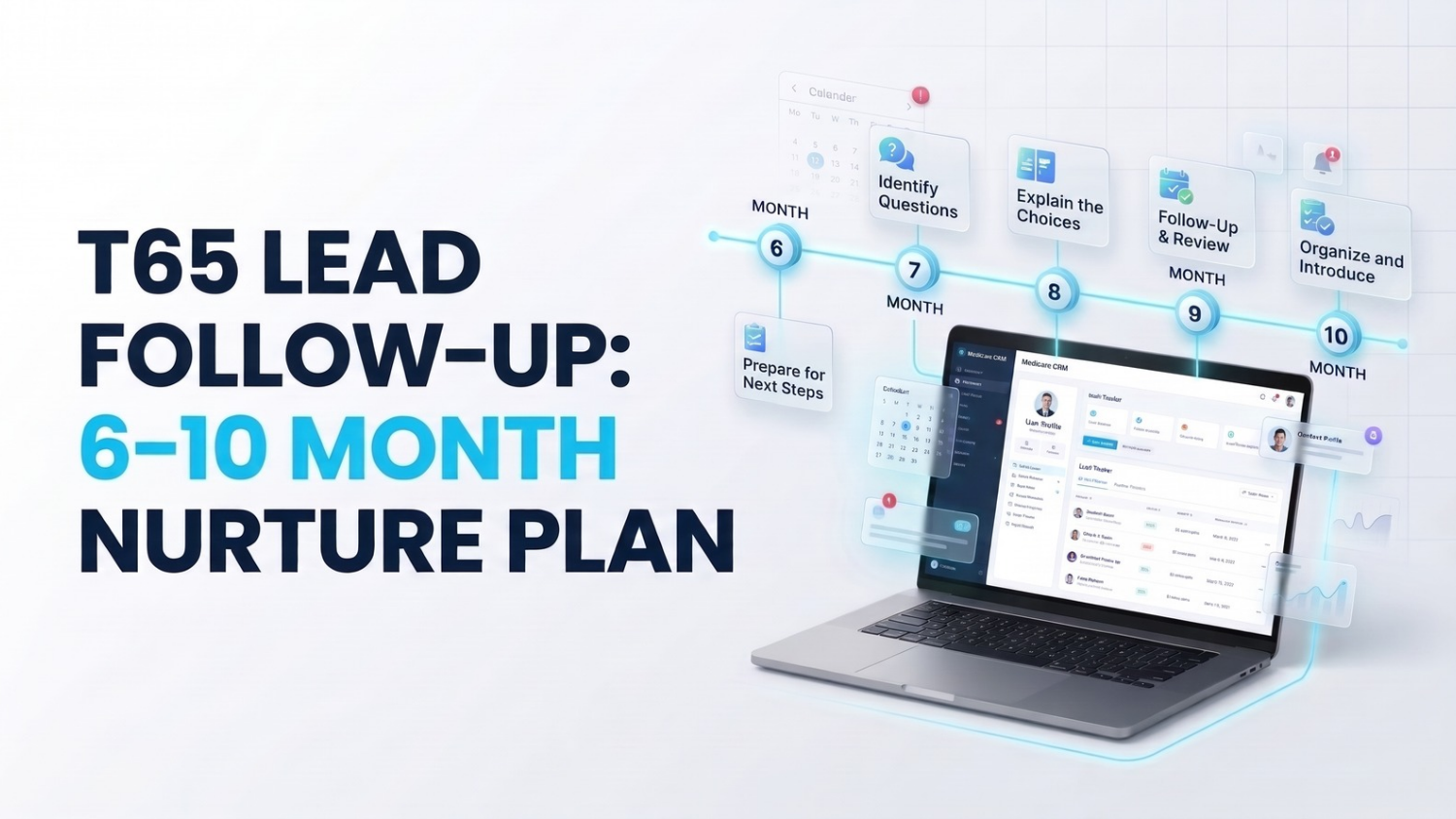
- Structured month-by-month cadence: Introduce yourself and confirm consent at Month 10, simplify Medicare parts at Month 9, contrast coverage routes at Month 8, deliver a preparation checklist at Month 7, and invite low-pressure consultations at Month 6.
- CRM automation requires stop conditions: Always halt automated educational campaigns immediately when a prospect books an appointment, replies with a question, or requests an opt-out.
- Compliance is non-negotiable: CMS rules strictly prohibit unsolicited telemarketing, robocalls, and unsolicited text messages for Medicare Advantage and Part D. Email marketing requires proper sender ID and functional unsubscribe links.
- Silence is not consent: Never treat lack of response as permission to intensify outreach across different channels. Keep touches respectful, consistent, and educational.
Introduction: Why T65 Leads Need a Different Follow-Up Strategy
If you work with turning-65 Medicare prospects, you already know that not everyone is ready to talk about coverage the moment their name enters your CRM.
Some people start researching Medicare months before they become eligible. Others are busy with work, retirement decisions, or simply trying to understand what Medicare means for them. And some won't pay much attention until their enrollment window gets closer.
That doesn't mean you should forget about them.
A well-planned T65 lead follow-up strategy keeps your agency organized, provides useful information over time, and helps prospects know where to turn when they're ready to ask questions.
The key is to start with education, build familiarity gradually, and make the next step clear when the timing is appropriate.
In this guide, we'll walk through a month-by-month nurture plan for prospects approximately 6–10 months away from turning 65, including what to send, when to follow up, how to use your CRM, and what to check before automating communications.
Why Start Following Up 6–10 Months Before Age 65?
Medicare has a learning curve. People may need time to understand Original Medicare, Medicare Advantage, Medicare Supplement Insurance, prescription drug coverage, and how enrollment timing works.
Starting early gives you an opportunity to explain the basics before a prospect feels rushed.
For many people becoming eligible at age 65, the Initial Enrollment Period generally spans seven months: it begins three months before the month they turn 65, includes their birthday month, and ends three months afterward. Important timing exception: If someone's birthday falls on the first day of a month, Medicare generally treats them as turning 65 during the preceding month. Their Initial Enrollment Period therefore begins one month earlier than it would for someone born later in that month. Employer coverage, disability-related eligibility, and other circumstances can affect an individual's enrollment situation.
For related guidance on organizing Medicare-related processes and documentation, see OmniReach's Medicare compliance requirements guide.
A few months of early education can help a prospect recognize important questions, gather information, and plan a conversation before their enrollment window begins.
For agents, early nurturing also helps prevent a common problem: collecting leads during a marketing campaign and then losing track of them because they're not ready to schedule an appointment immediately.
The goal isn't to contact someone every few days for ten months. It's to build a consistent, useful communication plan that respects their preferences and the rules governing Medicare marketing.
The 6–10 Month T65 Lead Follow-Up Calendar
Use this as a starting framework for leads who are six to ten months away from turning 65. The schedule assumes the prospect is eligible for the relevant communications and that the outreach method is permitted.
| Timing before age 65 | Main objective | Suggested action |
|---|---|---|
| 10 months | Organize and introduce | Confirm lead source, communication permissions, and eligibility timeline; send an introductory educational email where permitted |
| 9 months | Build awareness | Explain the basic parts of Medicare and invite questions |
| 8 months | Explain the choices | Introduce the broad differences between Original Medicare, Medicare Advantage, and Medicare Supplement Insurance |
| 7 months | Identify questions | Share a preparation checklist and offer a low-pressure way to request help |
| 6 months | Prepare for next steps | Review the prospect's timeline, update CRM tasks, and invite an appropriate conversation |
These are suggested nurture stages, not mandatory contact intervals. A prospect who responds, opts out, asks for less communication, or books an appointment should move out of the default sequence as appropriate.
Now let's look at each month in more detail.
Month 10: Organize the Lead and Make a Helpful First Introduction
At ten months out, the priority is to get the record right and establish a clear, professional introduction.
Before launching a campaign, check:
- The prospect's estimated 65th birthday and relevant Medicare eligibility dates.
- How the lead was obtained and what the prospect actually requested.
- Which communication channels are permitted based on the available consent and applicable rules.
- Whether the prospect has already been contacted by another agent on your team.
- Whether the lead is already active in another campaign or has requested no further contact.
Avoid treating a purchased list, a birthday record, or a phone number as permission for unrestricted outreach.
What should you send?
For eligible email outreach, start with a short introduction and a useful educational resource. You don't need to deliver a full Medicare lesson in the first message.
Subject: Starting to think about Medicare?
Hi {{contact.first_name}},
If you're approaching age 65, you may be starting to hear more about Medicare and wondering when you should begin learning about your options.
Over the coming months, I'll share straightforward information about Medicare enrollment timing, the different types of coverage, and questions you may want to ask as you prepare.
There's no need to figure everything out at once. If you have a question you'd like help with, you're welcome to reach out.
Best,
{{user.name}}
{{user.business_name}}
Include appropriate sender identification and a functional unsubscribe option for marketing email.
CRM task for Month 10
Create or update the contact record with the lead source, estimated eligibility timeline, communication permissions, assigned agent, and next review date.
A CRM should help you organize these details. It does not replace the need to establish valid permission or verify that an outreach method is allowed.
For more ideas on organizing leads from the beginning, read Medicare Lead Management Best Practices.
Month 9: Explain Medicare in Plain English
At nine months out, shift from introduction to education.
Many prospects have heard the terms Medicare Part A, Part B, Medicare Advantage, and Medigap without understanding how they relate to one another. Your job at this stage is to make the subject easier to understand—not overwhelm someone with every detail.
What should you cover?
A short educational email could explain:
- Original Medicare: The federal program that includes Part A and Part B.
- Medicare Advantage: An alternative way to receive Medicare Part A and Part B benefits through a Medicare-approved private plan.
- Medicare Supplement Insurance: Coverage that can help pay certain out-of-pocket costs associated with Original Medicare, subject to the policy's terms.
- Prescription drug coverage: How Part D works and why someone should review their prescription coverage needs.
Keep the first explanation broad. The details that matter most will depend on the prospect's circumstances and the products available where they live.
Example email topic
Subject: Four Medicare terms worth understanding before 65
Use this message to introduce the four topics above and direct the prospect to an educational resource on your website.
End with a simple invitation:
“Is there a Medicare term you'd like me to explain? Reply with your question, and I'll point you toward helpful information.”
This gives the prospect a natural way to engage without suggesting that they must schedule an appointment months before they're ready.
CRM task for Month 9
Record meaningful responses and questions. If a prospect asks for a call, follow the applicable contact and appointment procedures rather than leaving them in a generic email sequence.
Month 8: Help Prospects Understand the Main Coverage Differences
By eight months out, a prospect may be ready to understand the broad differences among coverage paths.
This is a good time to offer a simple comparison resource. Avoid trying to explain every plan design, exception, and enrollment rule in one email.
What should you explain?
Consider a short educational guide that addresses:
- How Original Medicare works.
- How Medicare Advantage differs from Original Medicare.
- How Medicare Supplement Insurance works alongside Original Medicare.
- Why provider access, prescription needs, costs, and personal circumstances matter when evaluating coverage.
- Why plan availability and rules can vary by location and individual situation.
A balanced explanation matters. For example, Medicare Advantage plans may use provider networks and other plan rules. Medicare Supplement policies generally work with Original Medicare and have different cost and coverage considerations. Neither option should be presented as automatically right for everyone.
Example email topic
Subject: Medicare Advantage or Medicare Supplement Insurance?
The email can introduce the basic differences and link to a relevant educational article on the OmniReach blog.
A reasonable call to action is:
“When you're ready, we can talk through the differences and identify which questions matter most for your situation.”
The invitation should make it easy to ask for help without implying that the agent can guarantee a particular outcome.
CRM task for Month 8
Track which educational resources a prospect requests or responds to, where the CRM and applicable privacy rules permit that tracking. Use the information to guide a relevant follow-up rather than sending every prospect the same collection of materials.
Month 7: Help Prospects Prepare Their Questions
At seven months out, move from general awareness toward practical preparation.
Many people are unsure what they need to know before making Medicare decisions. A checklist gives them something useful to work through at their own pace.
What belongs on a Medicare preparation checklist?
Suggest that prospects consider:
- When they expect to become eligible for Medicare.
- Whether they or their spouse will have employer-sponsored coverage.
- Which doctors and healthcare providers they want to continue seeing.
- Which prescription medications they currently take.
- Whether they expect to travel or live in more than one location.
- What questions they have about premiums, deductibles, and other out-of-pocket costs.
- Whether they need to investigate enrollment rules that apply to their employment or eligibility circumstances.
Be careful not to ask for sensitive health or financial details through a general marketing email. If a prospect wants to discuss personal information, use appropriate, secure processes.
Example email topic
Subject: A simple checklist before you enroll in Medicare
Offer the checklist and explain that the prospect doesn't need to have every answer yet.
You might say:
“Having a few questions written down can make a future Medicare conversation easier. Start with your expected eligibility date, your current coverage, and the doctors or medications you may need to consider.”
CRM task for Month 7
Create a reminder to review the prospect's timeline and engagement history. If they have asked for a personal conversation, assign a follow-up task to the appropriate licensed agent.
Don't automatically convert an educational email click into permission for a sales call or text. A click may show interest in a resource, but it is not necessarily consent to every type of contact.
Month 6: Review the Timeline and Invite an Appropriate Next Step
At six months out, it's reasonable to make the next step more visible while keeping the tone helpful.
This is a useful checkpoint to review what the prospect has received, whether they have engaged, and whether their eligibility timeline needs to be updated.
What should you do this month?
- Check the prospect's expected 65th birthday and enrollment timeline.
- Review the information already provided to avoid repetition.
- Identify unanswered questions or requested follow-ups.
- Offer a conversation to prospects who have indicated interest.
- Schedule the next appropriate educational touch for those who prefer to keep learning independently.
Example email topic
Subject: Want to make a plan for your Medicare questions?
Hi {{contact.first_name}},
As you get closer to 65, this can be a useful time to review your Medicare questions and understand the dates that may apply to you.
If you'd like to talk through the basics, you're welcome to request a conversation with a licensed agent. We can discuss your timeline, the coverage options available in your area, and what information you'll want to gather before making a decision.
If you'd rather keep learning for now, that's fine too.
Best,
{{user.name}}
{{user.business_name}}
CRM task for Month 6
Move engaged prospects into the appropriate follow-up stage. For prospects who aren't ready, keep only the communications that remain appropriate under their permissions and preferences.
A date-based workflow can create reminders, but the agent should still verify the individual's circumstances. Turning 65 does not mean every person follows the same enrollment path.
What Happens After the First Six Months?
The nurture process shouldn't stop simply because the initial sequence is complete.
As the prospect moves closer to age 65, the emphasis can gradually shift toward enrollment timing and preparation. A practical follow-up plan might include:
- Five months out: Review common Medicare questions and explain where to find enrollment information.
- Four months out: Invite interested prospects to discuss their situation and identify questions that need individual attention.
- Three months out: Help eligible prospects understand that the general Initial Enrollment Period begins three months before the month they turn 65. For someone born on the first day of a month, the enrollment period generally begins one month earlier because Medicare treats them as turning 65 in the preceding month. Check the individual's circumstances and dates rather than relying on a generic birthday calculation.
- Two months out: Follow up on conversations already requested or appointments already arranged. Help prospects identify unanswered questions.
- One month out: For prospects who have requested assistance, focus on their specific timeline and next steps. Avoid creating urgency that is not supported by their circumstances.
Enrollment rules can differ based on employer coverage, disability-related eligibility, and other individual circumstances. For a related discussion of Medicare processes and compliance considerations, see OmniReach's Medicare Compliance Requirements for Agents.
The point is to make follow-up more relevant as the date approaches—not simply to increase the number of messages.
How to Automate T65 Lead Follow-Up in Your CRM
A CRM can make a month-by-month plan much easier to manage, especially when your agency is working with prospects who have different birthdays and enrollment timelines.
Instead of manually checking a spreadsheet every morning, use date fields, contact stages, and reminders where your system supports them.
1. Create a Dedicated T65 Pipeline
Separate turning-65 prospects from other lead categories so you can see where each person stands.
Possible stages include:
- New T65 Lead
- Timeline and Permissions Reviewed
- Educational Nurture
- Engaged Prospect
- Conversation Requested
- Appointment Scheduled
- Follow-Up Required
- Enrolled or Closed
- Long-Term Nurture, if appropriate
Use stages that match your actual agency process. Don't label someone as ready to enroll merely because a birthday is approaching.
2. Use Date-Based Triggers
If your CRM supports date-based workflows, use the prospect's relevant eligibility date to create reminders for the appropriate nurture stages.
For example, a trigger could create an internal task six months before the expected 65th birthday. Subsequent tasks can remind the agent to review the record, confirm the next educational step, or check whether the prospect has requested assistance.
Date-based triggers are only as reliable as the underlying data. Verify dates and circumstances before sending time-sensitive enrollment information.
3. Add Stop Conditions
This is one of the most important parts of the workflow.
Your automation should check whether a prospect has:
- Requested an appointment.
- Asked for a personal follow-up.
- Enrolled or moved to another relevant stage.
- Opted out of marketing communications.
- Asked not to be contacted or requested a change in communication frequency.
Depending on the system's capabilities, these conditions may pause a sequence, remove the contact from a campaign, or create an internal task for review.
Your workflow should not continue sending generic educational emails after someone has asked for a conversation, and it must not continue marketing messages after an applicable opt-out.
4. Prevent Overlapping Campaigns
A prospect might enter your system through a T65 list, a website form, and a separate educational campaign. Without safeguards, the same person could receive multiple messages close together.
Review workflow entry rules, exclusions, and contact history. Test the process using sample records before launching it to a live audience.
For more detail, read How Medicare Agents Can Automate Follow-Up Without Losing the Personal Touch.
5. Track Outcomes and Improve the Sequence
Monitor measures such as:
- Delivery and bounce rates.
- Email engagement, where tracked lawfully and appropriately.
- Replies and requests for more information.
- Appointments requested and attended.
- Prospects who opt out.
- Leads who progress to the next stage.
- Complaints or repeated-contact concerns.
Review the results periodically. If a message isn't helping prospects understand Medicare or prompting meaningful engagement, improve the content rather than automatically increasing the frequency.
Explore OmniReach's Medicare lead management page for more information about organizing your pipeline.
Medicare Marketing Compliance: What to Check Before You Automate
Automation can help with consistency, but it doesn't make an otherwise impermissible communication compliant.
Before launching a T65 nurture campaign, check the source of each lead, the proposed communication channel, the prospect's permissions, applicable federal and state requirements, and any carrier-specific rules.
For a broader overview, read OmniReach's Medicare compliance requirements guide.
For Medicare Advantage marketing, federal beneficiary-contact rules permit unsolicited email subject to an opt-out option. Include a working unsubscribe mechanism in marketing emails and honor requests promptly.
Calls, Texts, and Voicemail
Don't assume that having a phone number authorizes a marketing call, automated call, voicemail, or text. Medicare Advantage rules restrict unsolicited telephone solicitation, robocalls, texts, and voicemail, subject to applicable exceptions.
TCPA and FCC requirements may impose additional obligations, including consent requirements for covered calls or texts. The details can depend on the technology used, the purpose of the communication, the consent obtained, and the relevant legal exceptions.
Keep evidence of consent and its scope, and review current requirements before launching outbound campaigns. A prospect's request for one type of contact should not automatically be treated as blanket permission for unrelated future communications.
Educational Content Versus Plan Marketing
Keep educational material accurate and distinguish general Medicare information from plan-specific marketing. When discussing Medicare Advantage or Part D products, follow the applicable CMS requirements and carrier review processes.
Don't promise savings, guarantee coverage, or suggest that every prospect will qualify for the same options.
Protect Personal Information
Collect only the information you need, restrict access appropriately, and use approved systems for sensitive information. Whether HIPAA applies to a particular agency, data set, or relationship depends on the circumstances; using a CRM alone does not establish compliance.
You can review OmniReach's HIPAA compliance features to learn more about the platform's stated approach to handling sensitive information. Evaluate the actual configuration and your organization's obligations before relying on any system for regulated data.
Review the Campaign Regularly
Medicare rules, carrier instructions, and state requirements can change. Review the campaign before each major enrollment season and whenever the relevant rules, products, or communication methods change.
Common T65 Follow-Up Mistakes to Avoid
Even a well-intentioned campaign can become ineffective if it isn't managed carefully.
- Sending too many messages: A steady, useful cadence is better than a constant stream of reminders. Adjust based on engagement and the prospect's stated preferences.
- Using the same content for every prospect: Someone who needs help understanding employer coverage may need different information from someone who simply wants to learn the difference between Medicare Advantage and Medicare Supplement Insurance.
- Treating silence as permission: No response is not consent to expand the types or frequency of contact.
- Ignoring the actual enrollment timeline: A birthday field can help organize reminders, but it doesn't tell you every detail about a person's eligibility or enrollment rights.
- Letting automation continue after a response: Make sure your system flags requests for assistance, pauses irrelevant messages, and routes conversations to a person when needed.
- Making promises about outcomes: Use educational language and explain that available options depend on individual circumstances and plan availability.
- Failing to measure results: If you don't review campaign performance, it's difficult to know whether the sequence is helpful or simply adding to your prospects' inboxes.
In Conclusion: Build the Relationship Before the Enrollment Window
A good T65 lead follow-up plan doesn't depend on one perfect script or a high volume of messages. It depends on showing up consistently with useful information, keeping accurate records, and recognizing when a prospect is ready for a conversation.
Start by organizing leads around their expected eligibility timeline. Use the first few months to explain Medicare basics, help prospects prepare questions, and gradually offer a conversation when appropriate. As the enrollment window approaches, focus on each person's actual circumstances and request next steps.
Your CRM can help coordinate reminders, track engagement, and prevent follow-up tasks from slipping through the cracks. The human side still matters: clear explanations, responsive service, and respect for a prospect's preferences.
If you're reviewing your current process, explore OmniReach's Medicare lead management resources or schedule a demo to see whether the available tools align with your agency's workflow.
The objective is straightforward: help people feel more prepared to ask questions about Medicare, while keeping your follow-up organized, appropriate, and respectful.
Build high-converting, compliant T65 nurture pipelines.
See how OmniReach CRM automates date-based follow-up, tracks enrollment timelines, and centralizes Medicare client communication.
Frequently Asked Questions
Q1: When should a Medicare agent start following up with T65 leads?
A useful starting point is six to twelve months before the expected eligibility date. The right timing depends on how the lead was obtained, the prospect's preferences, the communication method, and the individual's circumstances.
Q2: How often should I contact a T65 lead?
There is no single cadence that fits every lead or communication channel. A month-by-month educational framework can help organize the process, but you should account for engagement, contact permissions, opt-outs, and applicable CMS, TCPA, FCC, state, and carrier requirements.
Q3: Can I automatically text every prospect on a T65 list?
No. A T65 list or stored phone number does not, by itself, authorize every marketing text. Medicare beneficiary-contact rules restrict unsolicited texts, and TCPA requirements may also apply. Confirm that the proposed message, sender, technology, and consent meet the relevant requirements before sending.
Q4: What should a T65 lead nurture sequence include?
Consider Medicare basics, the general enrollment timeline, explanations of the main coverage types, a preparation checklist, and invitations to request assistance. Keep the information accurate, balanced, and appropriate to the prospect's stage.
Q5: Can a CRM automate T65 follow-up?
A CRM may support date-based reminders, contact stages, workflow triggers, opt-out tracking, and internal notifications, depending on its features and configuration. You still need to verify the underlying data, contact permissions, and compliance of each campaign.
Q6: What happens if a T65 prospect doesn't respond?
Don't assume silence means consent or interest. Continue only with communications that are otherwise permitted, avoid excessive repetition, and respect any request to stop or reduce contact. If the prospect later initiates a conversation, update the record and respond according to the request.
Q7: When does the Medicare Initial Enrollment Period begin?
For someone becoming eligible around age 65, the general Initial Enrollment Period is seven months long: it starts three months before the month they turn 65 and ends three months after that month. If the person's birthday is on the first day of a month, Medicare generally treats them as turning 65 in the preceding month, so their Initial Enrollment Period begins one month earlier. Other circumstances can affect eligibility and enrollment timing. Agents should confirm the applicable dates and circumstances before providing individual enrollment guidance.