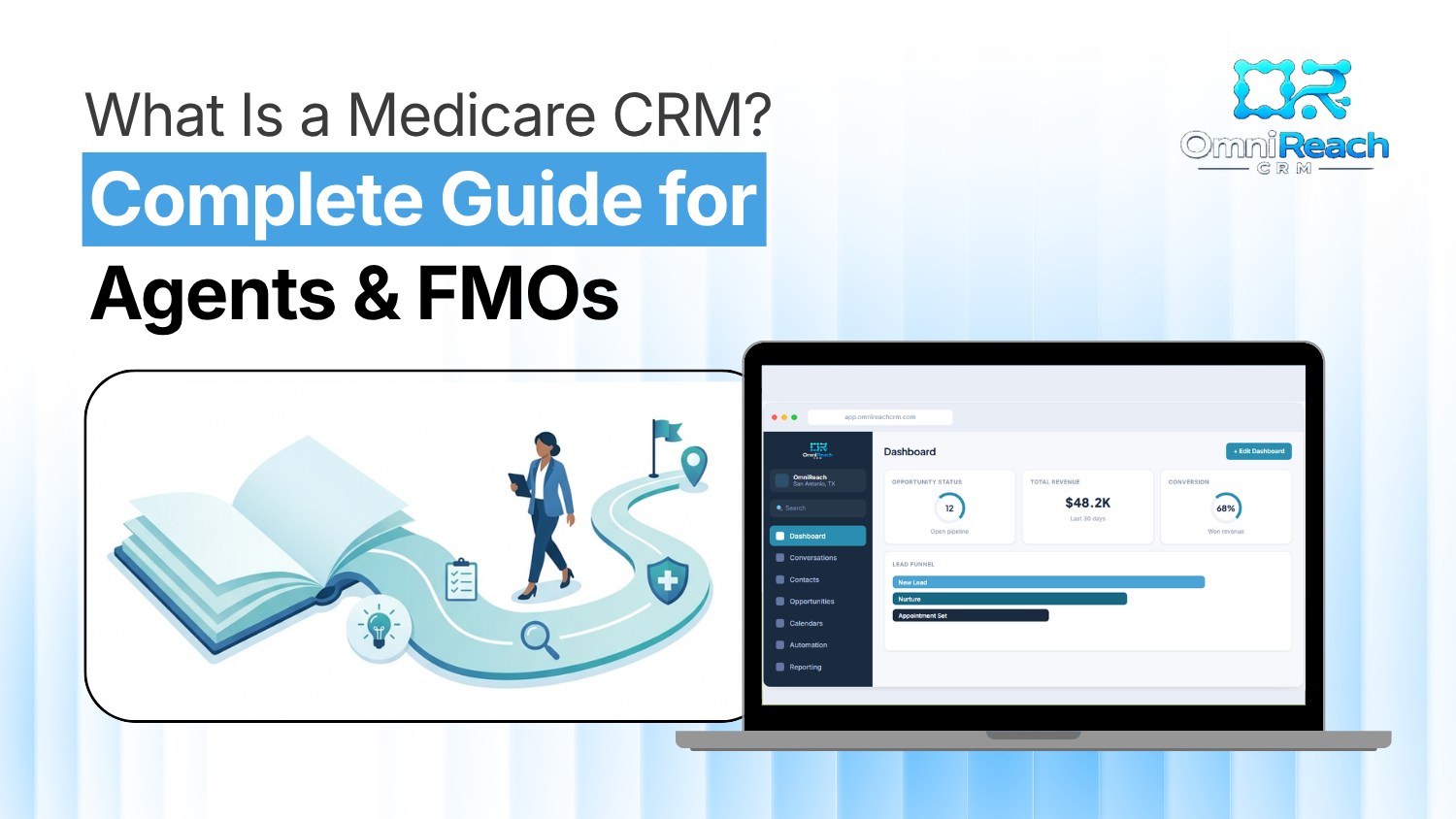
A Medicare CRM is a customer relationship platform built specifically for agents who sell Medicare Advantage, Medicare Supplement, and Part D plans. Unlike a generic sales CRM, it comes with insurance-specific pipeline stages, HIPAA-compliant messaging, and medicare plan automation that handles time-sensitive tasks like AEP follow-up, age-in-65 outreach, and SEP eligibility tracking without an agent lifting a finger. For FMOs, a CRM for Medicare agents also standardizes compliance and follow-up across an entire downline, so every producer — not just the most organized one — works leads the same way.
- A Medicare CRM is software built specifically for Medicare sales — not a repurposed generic CRM
- Medicare plan automation handles AEP timing, age-in-65 outreach, and SEP triggers without manual work
- HIPAA compliance (encryption, audit logs, a signed BAA) has to be built in, not bolted on
- A CRM for Medicare agents gives FMOs one standard process across an entire downline
- 55% of eligible Medicare beneficiaries are now on Medicare Advantage plans (KFF, 2026) — the volume alone makes manual tracking unrealistic
- Agents who respond within the hour are far more likely to actually reach a lead worth writing
What Is a Medicare CRM? A Straight Answer for Agents and FMOs
You've got a legal pad with fifteen names on it. Three are AEP leads from last week. Two need a callback about a plan change. One SOA got signed, but you can't remember if you scanned it anywhere.
This is the moment most agents start Googling "what is a Medicare CRM" — usually right after almost losing a lead they can't afford to lose.
Here's the direct answer: a Medicare CRM is customer relationship software built specifically for agents selling Medicare plans — not a general sales tool with an insurance label stuck on top. It knows what AEP is. It knows what a Scope of Appointment is. And it's built to keep you compliant while it does the follow-up work you don't have time for.
Let's get into exactly what that means.
What Is a Medicare CRM, Exactly?
Strip away the marketing language and a Medicare CRM does three things: it organizes your book of business, it automates the follow-up your leads actually need, and it keeps your communication compliant with CMS and HIPAA rules.
A generic CRM for Medicare agents can technically hold contact info. What it usually can't do is tell the difference between an MA lead and a Med Supp lead, remind you when someone's about to age into Medicare, or produce a clean audit trail the day CMS asks for one.
Why a Regular CRM Falls Apart for Medicare Work
Sales software built for real estate or car dealerships wasn't designed around your calendar. AEP hits every fall, and your lead volume can triple overnight. A generic tool has no idea that's coming.
It also has no idea what to do with protected health information. The second a client's health status enters a text thread, HIPAA applies — and most general CRMs were never built with that requirement in mind.
CMS also expects clean records if a client disenrolls — reason codes, dates, the works. A regular system wasn't built to produce that on request, which means you're stuck rebuilding it by hand the day someone asks.
Here's the difference laid out plainly:
| Feature | Generic CRM | Medicare CRM |
|---|---|---|
| Built around insurance sales | No — generic deal stages | Yes — MA, Med Supp, PDP, FE stages ready to go |
| HIPAA-compliant messaging | Rarely included | Encrypted, with a signed BAA |
| AEP-ready automation | You build it yourself | Pre-loaded enrollment period sequences |
| SOA and compliance tracking | Manual, easy to lose | Logged automatically |
| Pricing as your book grows | Often per-seat | Usually flat, regardless of contact count |
Medicare Plan Automation: The Part That Actually Buys You Time
This is where a Medicare CRM earns its keep. Medicare plan automation means the system takes over the repetitive, time-sensitive work that usually falls through the cracks — without you having to remember to do it.
A few examples of what that looks like in practice:
- A lead comes in during AEP and gets a text within minutes, not hours
- Someone about to turn 65 gets added to an age-in sequence automatically, months ahead of their birthday
- A client who mentions a move or a Medicaid change gets flagged for an SEP conversation
- Renewal season triggers a check-in campaign without anyone building it from scratch
None of this is optional once you understand what slow follow-up actually costs. A widely cited Harvard Business Review audit of over 2,200 companies found the average business takes about 42 hours to respond to a new lead — and firms that responded within the first hour were roughly seven times more likely to have an actual conversation with that prospect. In an AEP window that lasts less than two months, 42 hours is a lead you don't get back.
This kind of automation exists specifically to close that gap — every time, for every lead, without depending on how busy your day already is.
Where FMOs Come Into This
If you're reading this as an FMO, the value multiplies fast. An FMO with CRM support in place isn't chasing forty agents for status updates or hoping everyone remembers the SOA rules. The system runs the same for every producer, whether they've been licensed for ten years or ten days.
An FMO with a CRM behind the whole downline also gets something spreadsheets never provide: one place to see who's actually working their leads, and who's falling behind before it shows up in the numbers.
We covered this side in more depth in how FMOs manage downline agents with a CRM — worth a read if you're managing more than a handful of producers.
Signs You're Overdue for One
- You've got AEP leads split across texts, a notebook, and your email inbox
- You couldn't say, without checking three places, who signed an SOA this week
- Your FMO has asked for a compliance record you had to go dig up
- You're manually remembering which clients are turning 65 this year
- You're re-entering the same client details in three different places
- A hot lead went cold because you were on another call when it came in
If two or more of these sound familiar, you're already paying the cost of not having one — you're just paying it in lost commissions instead of a monthly bill.
Why This Category Grew So Fast
Medicare CRM tools didn't show up by accident. More than half of eligible Medicare beneficiaries — 55% as of 2026, according to KFF — are now enrolled in Medicare Advantage, with enrollment topping 35 million people. That's a lot of plan comparisons happening every single AEP, and CMS marketing rules keep getting stricter around how agents can communicate with them.
Software built by people who've actually sat across from an agent juggling AEP call volume looks different from software adapted from a generic sales playbook. For an FMO with CRM support running under the whole downline, that growth curve is exactly why waiting on standardized compliance isn't really an option anymore.
Conclusion
A Medicare CRM isn't a nice-to-have anymore — it's the difference between a book of business you can see clearly and one you're managing from memory. It handles medicare plan automation so leads get touched on time, keeps you HIPAA-compliant without extra effort on your part, and gives FMOs a way to run an entire downline the same way, every time.
Keep working off a notebook and a good memory, and you'll keep losing leads to whoever calls back first. Or put a real CRM for Medicare agents behind your book and stop finding out about the gaps after they've already cost you a policy.
Ready to Stop Losing Leads to Slow Follow-Up? Here's What OmniReach CRM Does Differently
Every AEP, agents without the right system lose policies they should have written — not because they didn't work hard enough, but because a lead sat for two hours while they were on another call.
OmniReach CRM was built around exactly the problem this article just walked through. Automated follow-up that fires the moment a lead comes in — no manual triggering required. Pipelines already set up for MA, Med Supp, PDP, and FE. Full HIPAA compliance from day one — no upgrade, no add-on. And if you're an FMO, one dashboard that shows your entire downline instead of forty separate guesses.
Explore what's included on the pricing page, see SMS automation and AI voice handle the busywork in a live demo, or just start today.
AEP doesn't wait for anyone to get organized. Neither do your leads. [Book a Demo →]
Frequently Asked Questions
Q1: What exactly makes a Medicare CRM different from any other
CRM?
A Medicare CRM comes pre-built for insurance sales — MA,
Med Supp, PDP, and FE pipeline stages, HIPAA-compliant messaging,
and medicare plan automation designed around AEP and SEP timing. A
generic CRM has none of that built in from the start.
Q2: I'm a solo agent, not part of an FMO. Do I still need
one?
Yes. The compliance risk and the lost-lead problem exist
whether you're solo or managing a downline of 200. A CRM for
Medicare agents just makes both easier to manage as a one-person
operation.
Q3: Is medicare plan automation actually compliant with CMS
marketing rules?
It should be — that's the entire point of choosing
insurance-specific software over generic marketing tools. Look for
platforms that build CMS-aware messaging and disclaimers into the
automation itself, not as something you have to configure
correctly yourself.
Q4: Can an FMO really put one CRM in front of every agent in a
downline?
Yes, and it's one of the biggest reasons FMOs adopt this
kind of software. An FMO with CRM support can standardize pipeline
stages and follow-up sequences across every producer, while still
keeping each agent's book private to them.
Q5: How fast can I actually get set up before AEP hits?
Most agents are working leads within a few days using
pre-built pipelines. Texting requires standard carrier
registration first, which can take a little longer — but
everything else is ready from the moment you log in.
See OmniReach CRM in Action
OmniReach fires your first follow-up in under 2 minutes for every new lead, automatically, across every source. Book a 20-minute demo and we'll show you the full platform live.
Book a Free Demo →